Menstruating is a monthly event with a monthly cost. But for those without much flexibility in their budget, menstruation gets complicated.
By Anna Bourgogne

Have you ever paid attention to a few extra dollars on your monthly bills? I assume that the answer would be ‘no’, especially if it went towards the purchase of a necessity. Unfortunately, menstrual hygiene products can be the few extra dollars that women in need can’t afford. Today, I want to give you more information about the ways we can help women in need cope with menstruation more easily. This blog post will cover the following subjects:
- The Financial burden
- The vulnerability burden
- Menstruation without a home
- Menstruation complications
The Financial Burden
The most important issue of menstruation for women in need lies in the cost of feminine hygiene products. An interesting article revealed that the average Canadian woman spends on average $65/year on essential feminine hygiene products (Gurman, 2017). It might sound low to you, but that comes to a $5 average per month. Yes, it’s nothing, but for some, it is traded for a meal!
Menstruation pads are part of the 12 basic items that the Women’s Centre constantly requires to adequately help women in need. Normally, you can drop off these items at their location, but with the current COVID-19 situation, they unfortunately had to close the Centre to preserve everyone’s health. You can read our blog post about donation boxes here. So, don’t forget to put a few feminine hygiene products in your donation box in the meantime until they reopen.
I would like to dive into more details with this $5 average on menstruation hygiene products. It is only for the very essentials, by which I mean pads and tampons. It does not include medication for pain or hot water bags and chocolates to feel more comfortable. While we prioritize donating the most required items, it can be interesting to think about donating non-essential items, like hot water bags for example. They will be greatly appreciated!
The Vulnerability Burden
While the concept of monthly menstruation itself is already not a walk in the park for all women, imagine adding it to a state of vulnerability, financial distress, and uncertainty about your professional future. Suddenly, this minor inconvenience turns into hell. If we can help women by giving them just one less thing to worry about, it can make a huge difference! This week, we want to focus our donating actions on menstruation specifically. Don’t forget to add a few boxes of pads and tampons to your donation box!
Additionally, it is important to understand what type of side-effects women may face monthly, to better understand the burden that it becomes for a woman in need. For instance, a woman who faces extreme menstrual cramps might not be able to attend work, and if she works on contract, the economic losses can be very heavy.
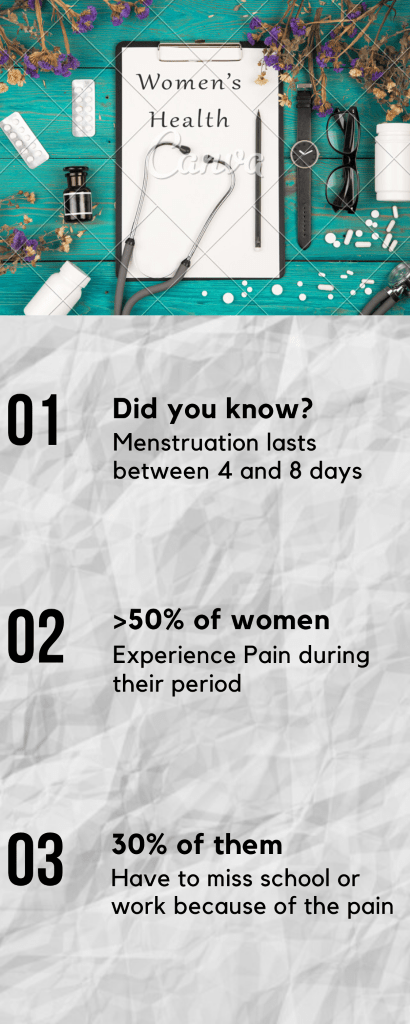
Statistic source: (Holland, 2018).
Menstruation Without a Home
Homelessness and menstruation is a relatively overlooked subject. Though all women in need do not face homelessness, not having a home makes menstruation even more complicated for many.
I remember when I stumbled upon this video talking about the way homeless women cope with their period. Not only was I horrified by how challenging it can be for vulnerable women to have one more burden to deal with, I was also upset with myself for not thinking about this need earlier!
This short video will help you gain a better understanding of the way homeless women cope with their period. It follows a few homeless women who explain how they cope with menstruation on the street in New York when they can’t afford to buy adequate products. Believe me, it changed the way I view menstruation for women in need forever.
Menstruation Complications
Besides feminine hygiene products, it is important to mention that there are period-related illnesses and complications that exist. Here you can see the most common ones:

Statistic source: (Holland, 2018).
As you can see, these complications can be very disrupting and even dangerous physically and emotionally. While it is important to donate basic items, it is also crucial to give women all the resources they need to deal with menstruation complications, as a woman in need might not have the opportunity, knowledge, or enough time or adequate healthcare to consult a doctor. Helping women also requires providing them with an easy path to take care of their health if they need to.
The Women’s Centre has a list of health services for women, and you will find a selection below of the ones that apply to women’s health. Helping women goes beyond material items, and you can also help by recommending any of these institutions to women who might need them. It is important for all women to know when and where to seek medical advice, and to be educated about potential health issues that might arise with menstruation.
Here is the list of resources from the Women’s Centre of Calgary:
- Alberta Adult Health Benefits – to know what services are covered by Alberta Healthcare for adults.
- Alberta Child Health Benefits – to know what services are covered by Alberta Healthcare for children.
- Centre for Sexuality – for information related to sexuality.
- CUPS Community Health Centre – for free health and mental service in Calgary if you don’t have Alberta Healthcare.
- HIV Community Link – all resources about HIV in Calgary.
- Sheldon M. Chumir Health Centre – for health services from addiction and mental health to their sexual assault response team.
These resources will help women not only with menstruation complications, but women’s and sexual health in general.
Menstruation, or Lack Thereof
While I have spent the most part of this blog article explaining how much of a burden menstruation can be for women in need, missing a period is sometimes not wanted either! Therefore, I wanted to bring to your attention another basic item that the Women’s Centre needs, and it is pregnancy tests. Don’t forget to add a few of those to your donation boxes if you can… They might come in seriously handy!
To learn more:
- Average yearly spendings of Canadian women on feminine hygiene products https://www.chatelaine.com/living/how-much-do-periods-cost/
- A few facts about menstruation https://www.healthline.com/health/facts-statistics-menstruation#3
- More resources that the Women’s Centre lists https://www.womenscentrecalgary.org/get-assistance/resources/
- Additional videos about homeless women & menstruation:
- https://www.youtube.com/watch?v=yjtmazHTU7s
- https://www.youtube.com/watch?v=K6fYLq7O0j4
- https://www.youtube.com/watch?v=9_H6zTjjQ6Y
References
Bustle (2016, October 18). How do homeless women cope with their periods . Youtube. Retrieved from https://www.youtube.com/watch?v=ABch4VYOJZ0
Gurman, E. (2017, June 16). How much do Canadian women actually spend on tampons and pads each year? Chatelaine. Retrieved from https://www.chatelaine.com/living/how-much-do-periods-cost/
Holland, K. (2018, November 28). Menstruation: facts, statistics, and you. Healthline. Retrieved from https://www.healthline.com/health/facts-statistics-menstruation#1
Women’s Centre. (2020). Resources. Get Assistance. Retrieved from https://www.womenscentrecalgary.org/get-assistance/resources/
 YYC for Women